
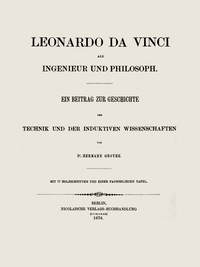
Leonardo da Vinci als Ingenieur und Philosoph by Hermann Grothe
Forget everything you think you know about Leonardo da Vinci. In this 19th-century deep dive, Hermann Grothe isn't interested in the Mona Lisa. He's obsessed with the notebooks—thousands of pages where Leonardo let his true mind run free. Grothe guides us through these chaotic journals, translating rough sketches and mirror-writing into a clear argument: Leonardo's heart belonged to engineering and natural philosophy.
The Story
There isn't a traditional plot, but there is a compelling narrative thread. Grothe structures his book as a detective story, following the clues Leonardo left behind. He starts by showing us the public face: the celebrated court artist. Then, he flips to the private pages, revealing a man designing futuristic war machines, studying the flight of birds to dream of human aviation, and dissecting corpses to map the human engine. The "story" is the unraveling of a contradiction. Why did this brilliant engineer spend so much time painting? Grothe suggests it was partly for money and patronage, but also because, for Leonardo, understanding light, shadow, and anatomy for art was inseparable from understanding them as science.
Why You Should Read It
This book changes your perspective. It makes you see the Last Supper not just as a religious scene, but as a masterful study of perspective and geometry. You realize his paintings were experiments. Grothe's passion is infectious; he writes like someone who has uncovered a secret and can't wait to share it. The book feels like a time capsule, too. Reading a perspective from the 1880s on a 1500s genius adds a fascinating layer—it shows what Victorians found remarkable about the Renaissance. You get a sense of awe that hasn't been dulled by modern biographies.
Final Verdict
This is a perfect read for curious minds who love history but want to look beyond the standard biography. It's for the person who geeks out over how things work. Be warned, it's an older text, so the language is formal in places, but Grothe's excitement cuts through. If you only know Leonardo as 'the painter,' this book will open a door to a workshop full of gears, blueprints, and breathtakingly bold ideas. It’s a brilliant reminder that true genius can't be confined to one canvas.
Edward Moore
1 year agoNot bad at all.
Christopher Young
1 year agoPerfect.
Daniel Thomas
2 months agoNot bad at all.
Paul Lopez
1 month agoFinally found time to read this!

Dorothy Allen
1 year agoText is crisp, making it easy to focus.