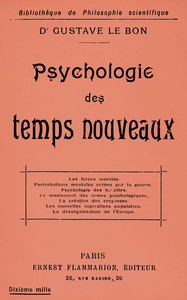
Psychologie des temps nouveaux by Gustave Le Bon
Gustave Le Bon's Psychologie des temps nouveaux isn't a novel with a plot in the traditional sense. Instead, it's a deep dive into the psychology of the crowd at a time when 'the crowd' was becoming a powerful new force in society. Think late 1800s: newspapers are spreading ideas faster than ever, cities are growing, and political movements are rallying the masses. Le Bon watches this happen and asks a fundamental question: What changes in a person when they stop being an individual and become part of a group?
The Story
The 'story' here is Le Bon's investigation. He observes that people in crowds don't act like themselves. They become more emotional, more suggestible, and less rational. He breaks down how this happens. First, he says, there's a sense of anonymity—you feel less responsible. Then, ideas and emotions spread through the crowd like a contagion. Finally, individuals become highly susceptible to the influence of a leader who can use simple, powerful images and repetition. The book walks us through this process, using examples from history and his contemporary world to show how crowds can be heroic, cruel, or easily manipulated.
Why You Should Read It
Reading this book is a bit eerie because it feels so current. When Le Bon describes how crowds crave simple answers and are driven by images, not logic, you can't help but think of modern politics or social media trends. His insight isn't always comforting—he has a pretty dim view of mass behavior—but it's incredibly useful for understanding the world. It gives you a framework to think about everything from viral internet crazes to large-scale social movements. It reminds you to step back and question the emotional pull of the group.
Final Verdict
This book is perfect for anyone curious about human behavior, politics, or history. If you've ever scrolled through a comments section and wondered, 'Why is everyone thinking this way all of a sudden?' Le Bon offers a compelling, century-old explanation. It's also a great, foundational read for students of psychology or sociology. A word of caution: some of his views, particularly on race and gender, are very much products of his time and are jarring to a modern reader. Read it for his groundbreaking analysis of crowd psychology, but take his broader social conclusions with a large grain of salt. It's a short, provocative book that will definitely give you something to think about.