
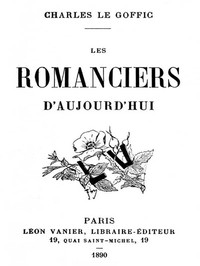
Les Romanciers d'Aujourd'hui by Charles Le Goffic
Published in 1890, Les Romanciers d'Aujourd'hui is Charles Le Goffic's snapshot of the French literary world at a specific moment in time. It's a series of critical essays, each one focusing on a different novelist who was shaping the landscape. Le Goffic doesn't just give dry summaries; he offers sharp opinions, analyzes their styles, and places them in the broader currents of Naturalism, Idealism, and Decadence that were swirling around. The book reads like a series of thoughtful, sometimes cheeky, literary profiles.
The Story
There's no traditional plot. Instead, the 'story' is the unfolding map of late-19th century French fiction that Le Goffic draws for us. He takes us from established giants to fresh new voices. We meet writers obsessed with grim social realism, others crafting delicate psychological studies, and some chasing pure artistic beauty. The book's structure is its journey, moving from one author's world to the next, building a complete picture of what 'the novel' meant to people in that era. It’s less about a single narrative and more about understanding the creative ecosystem.
Why You Should Read It
This book is a blast for anyone who loves literary history. Le Goffic has a real voice—he's witty, passionate, and not afraid to call a boring book boring. Reading it today is a strange and wonderful experience. You cheer when he champions an author who became a classic, and you get a weird thrill when he spends pages on someone completely forgotten. It reminds you that literary fame is fragile. Most of all, it humanizes these often-monumental figures. They weren't just names in a textbook; they were his contemporaries, his rivals, his friends. You feel the living, breathing, and arguing literary scene.
Final Verdict
Perfect for curious readers and history buffs who want to go beyond the standard classics list. If you've ever enjoyed authors like Zola, Maupassant, or the Goncourt brothers, this book provides the context they were writing in. It’s also great for writers, as it’s a masterclass in critical thinking about style and theme. A word of caution: it’s a book about novels, not a novel itself. But if you're in the mood for a smart, conversational trip to a Parisian literary café in the 1890s, with a very opinionated guide, this is a hidden gem.




Elijah Garcia
1 year agoAfter hearing about this author multiple times, the content flows smoothly from one chapter to the next. Absolutely essential reading.